Tuesday, July 17, 2007

Say Hello to My Little Friend!

The legendary actor, Al Pacino has remained one of Hollywood's premier actors throughout his lengthy career, a popular and critical favorite whose list of credits includes many of the finest movies of his era. Pacino was born on April 25, 1940, in East Harlem, New York. Raised in the Bronx, Pacino attended the legendary High School for Performing Arts, but dropped out at the age of 17. He spent the next several years drifting from one job to another, continuing to study acting and occasionally appearing in off-off-Broadway productions. In 1966, Pacino was accepted to train at the Actors' Studio, and after working with James Earl Jones in The Peace Creeps, he starred as a brutal street youth in the off-Broadway social drama "The Indian Wants the Bronx", earning an Obie Award as Best Actor for the 1967-1968 theatrical season. A year later, he made his Broadway debut in "Does the Tiger Wear a Necktie?" Although the play itself closed after less than 40 performances, Pacino was universally praised for his potent & charismatic portrayal of a sociopathic drug addict, and he won a "Tony Award" for this performance.

Al Pacino made his film debut in the 1969 flop "Me, Natalie". After making his theatrical directorial debut with 1970's Rats, he returned to the screen a year later in "Panic in Needle Park", again appearing as a junkie. (To prepare for the role, he and co-star Kitty Winn conducted extensive research in known drug-dealer haunts as well as methadone clinics.) Despite the film not being a hit, Pacino still earned critical raves. Next came Francis Ford Coppola's 1972 Mafia epic "The Godfather". As Michael Corleone, the son of an infamous crime lord reluctantly thrust into the family business, Pacino shot to stardom, earning a Best Supporting Actor Oscar nomination for his soulful performance. While the follow-up, 1973's Scarecrow, was received far less warmly, the police drama Serpico was a smash, as was 1974's The Godfather Part II for which he earned his third Academy Award nomination. The 1975 fact-based "Dog Day Afternoon", in which Pacino starred as a robber attempting to stick up a bank in order to finance his gay lover's sex-change operation, was yet another staggering success.

The 1977 auto-racing drama "Bobby Deerfield", on the other hand, was a disaster. Pacino then retreated to Broadway, winning a second Tony for his performance in the title role in The Basic Training of Pavlo Hummel. Upon returning to Hollywood, he starred in "And Justice for All", which did not appease reviewers but restored him to moviegoers' good graces. Pacino next starred in William Friedkin's controversial Cruising, portraying a New York City cop on the trail of a serial killer targeting homosexuals; it was not a hit, nor was the 1982 comedy Author! Author! Brian DePalma's violent 1983 remake of Scarface followed; while moderately successful during its initial release, the movie later became a major cult favorite. Still, its lukewarm initial reception further tarnished Pacino's star. However, no one was fully prepared for the fate which befell 1985's historical epic Revolution; made for over 28 million dollars, the film grossed not even one million dollarsa at the box office. Pacino subsequently vanished from the public eye, directing his own film, The Local Stigmatic, which outside of a handful of 1990 showings at the Museum of Modern Art was never screened publicly. While his name was attached to a number of projects during this time period, none came to fruition, and he disappeared from cinema for over four years.

Finally, in 1989, Pacino returned with the stylish thriller "Sea of Love"; the picture was a hit, and suddenly he was a star all over again. A virtually unrecognizable turn as a garish gangster in 1990's Dick Tracy earned him a sixth Oscar nomination, but The Godfather Part III was not the financial blockbuster many anticipated it to be. The 1991 romantic comedy "Frankie and Johnny" was a success, however, and a year later Pacino starred in the highly regarded Glengarry Glen Ross as well as Scent of a Woman, at last earning an Oscar for his performance in the latter film. He reunited with DePalma for 1993's stylish crime drama Carlito's Way, to which he'd first been slated to star in several years prior. Remaining in the underworld, he starred as a cop opposite master thief Robert De Niro in 1995's superb Heat, written and directed by Michael Mann. Pacino next starred in the 1996 political drama City Hall, but earned more notice that year for writing, directing, producing, and starring in Looking for Richard, a documentary exploration of Shakespeare's Richard III shot with an all-star cast. In 1997, he appeared with two of Hollywood's most notable young stars, first shooting Donnie Brasco opposite Johnny Depp, and then acting alongside Keanu Reeves in The Devil's Advocate. Following roles in The Insider and Any Given Sunday two-years later, Pacino would appear in the film version of the stage play Chinese Coffee (2000) before a two-year perios in which the actor was curiously absent from the screen. Any speculation as to the workhorse actor's slowing down was put to rest when in 2002 Pacino returned with the quadruple-threat of Insomnia, Simone, People I Know and The Farm. With roles ranging from that of a troubled detective investigating a murder in a land of eternal sunlight to a film producer who sucessfully establishes the worlds first virtual actress, Pacino proved to filmgoers that he was as versitile, energetic and adventurous an actor as ever.

Saturday, June 23, 2007

Scarface (1983) - Soundtrack - Rush Rush (Get The Yayo)

Scarface (1983) - THE SCREEN TEXT


INTRODUCTION (Video version)

In May 1980, Fidel Castro opened the harbor at Mariel, Cuba, with the apparent intention of letting some of his people
join their relations in the United States. Within seventy-two hours, 3,000 U.S. boats were heading for Cuba. It soon became
evident that Castro was forcing the boat owners to carry back with them not only their relations, but the dregs of his jails.
Of the 125,000 refugees that landed in Florida, an estimated 25,000 had criminal records.


INTRODUCTION (Televised version)

In April 1980, Fidel Castro opened the harbor at Mariel, Cuba, allowing an estimated 125,000 people to emigrate to the
United States. This group of refugees included a very small number of violent criminals released from Castro's jails. This
movie is a fictitous account of one of those Mariel criminals who arrived in Miami that year.


CASTRO'S WORDS

...they are unwilling to adapt to the spirit of our revolution...

We don't want them! We don't need them!


UPI PRESS RELEASE

MIAMI, FLORIDA, AUGUST 11, 1980 (UPI)

HUNDREDS OF CUBAN REFUGEES BEGAN RIOTING THIS MORNING AT A DETENTION
CENTER SITUATED UNDER INTERSTATE 95 IN NORTH MIAMI, BURNING TENTS AND ATTACKING IMMIGRATION AND NATURALIZATION GUARDS
WITH PIPES, STICKS, AND ROCKS...

Saturday, June 16, 2007

Angelina Jolie slams West for barring refugees


Hollywood star Angelina Jolie on Tuesday accused the West of cold-heartedness and hypocrisy in trying to shut out migrants, including refugees, from Africa and other hotspots.


More than 7,000 people have died trying to get into Europe over the past decade, according to Jolie, whose comments appeared in the magazine “Refugees”, published by the U.N. High Commissioner for Refugees (UNHCR), for whom she is a goodwill ambassador.

She expressed outrage at a photo which appeared recently in the quarterly magazine, taken on an unidentified Mediterranean beach in Spain in 2002, which showed a couple relaxing under an umbrella not far from the washed-up corpse of a black man.

“We’ll never know who he was or why he ended up there and the couple on the beach apparently couldn’t care less,” Jolie wrote. “Someone’s son, someone’s brother, or someone’s loved one. In fact, you or me, if we had been born at another time, or in another place.”

Jolie, who has been to more than 20 countries since becoming a UNHCR goodwill ambassador five years ago, said it was a scandal that such a rich world was not feeding all people in refugee camps, especially in Africa.

Many would-be refugees fell into the hands of unscrupulous smugglers “who push them into overcrowded boats or hide them in the backs of containers, or tell them to walk across minefields or scale barbed wire fences in the middle of the night”.

“Many have also died trying to get into the United States and Australia. But we don’t notice,” wrote the Oscar-winning actress, who is filming in India.

Ignoring simmering conflicts had proven damaging and expensive, she said, citing Bosnia, Rwanda and Afghanistan.

“I have been to some of these countries, or to their neighbours, where most of the refugees remain,” said Jolie.

“It is a truly humbling experience, a shocking eye-opener. It has made me realise that we are all — myself included — behaving like the couple sitting under their umbrella on the beach, gazing studiously out to sea,” she said.

Technorati

Al Pacino to Dance with the Stars?

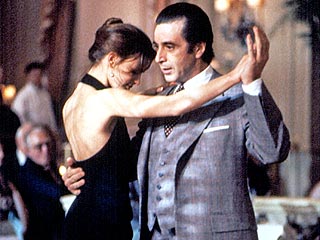
Gabrielle Anwar and Al Pacino in Scent of a Woman
Photo by: Universal / Courtesy Everett Collection


Al Pacino, rhumba king? It could happen.

The actor, 67, who plays nefarious casino owner Willie Bank in Ocean's Thirteen, tells TIME he wouldn't rule out appearing on the ABC reality competition – although fans probably shouldn't hold their breath.

In the magazine's "10 Questions" feature, a reader asks Pacino, who won an Oscar after tangoing with Gabrielle Anwar in 1992's Scent of a Woman: "I know you are a private person, but I hear that you can really dance. Would you consider doing Dancing with the Stars?"

He replies: "Actually, I would consider it. All due respect and trying to be as modest as I can be, I am a dancer. But I don't think I would be on Dancing with the Stars mainly because I would be too shy."

Pacino also sounds off on hip-hop artists who worship Scarface ("It's amazing to me. It's wonderful"), who does the best Pacino impression ("Kevin Spacey comes close. Jamie Foxx does a good rendition of me. ... It's sort of like having a talent for playing an instrument") and retirement ("I was shocked when I heard about Paul Newman retiring at age 82. Most actors just fade away like old soldiers").

The 2007 recipient of the American Film Institute's lifetime achievement award, Pacino muses on the possibility of a movie about his life. "It would be called The Dustin Hoffman Story," he quips. "When we were starting out, [Robert] De Niro, me and Hoffman were always sort of mixed up. People mistook us for each other."

Bob Marley album to be celebrated with new film

The 30th anniversary of the release of Bob Marley's classic 'Exodus' album will be celebrated with a series of special movie screenings in the UK this summer.

Marley will be marked with a series special screenings of 'Bob Marley & The Wailers - Exodus Live At The Rainbow' in eight Odeon cinemas, "from Manchester to Basingstoke", on June 26.

There will also be a special VIP screening at the Odeon in Covent Garden in central London on June 19, which will include an introduction and Q&A by his son Stephen Marley.

A specially-packaged 30th Anniversary DVD of 'Exodus Live At The Rainbow' will be released on June 18.

'Exodus' was recently reissued on four different audio formats, including standard and deluxe CDs, on vinyl and as USB Memory Stick.

For more information on the screenings, including venues and times, go to Dandeentertainment.com/marley.html.

Kevin Costner Forgives Madonna for Truth or Dare Diss

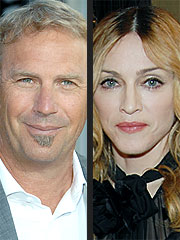
Costner and Madonna
Photo by: Jon Kopaloff / FilmMagic; Dimitrios Kambouris / WireImage


Kevin Costner has forgiven Madonna for making fun of him in her 1991 documentary Truth or Dare.

In the film, Costner visits Madonna backstage after a concert and describes the performance as "neat." After he leaves, Madonna pretends to stick her finger down her throat and says, "Anybody who says my show is 'neat' has to go."

"Yeah, I was embarrassed by it and kind of hurt by it," Costner, 52, tells the L.A Times. "I just went back there because I was asked to go back. And I found the best word that I could. I never called her on it or whatever."

A decade later, Madonna, to Costner's surprise, made things right. "She did a really beautiful thing," he says. "She was performing [in L.A.] about three or four years ago, so I decided to take my daughters to see her. I just thought this is somebody they should see. I didn't call anybody for tickets, I just got tickets and we went down.

"And about the third song in, the lights were down, and she said, 'I want to apologize to someone.' And all of a sudden my face starts to get hot. ... She says, 'I want to apologize to Kevin Costner.' She just said it very simply. Ninety-eight percent of that audience didn't know what she was talking about. But I really respected that, and it showed me the power of just keeping your own counsel for a long time. ...

"Whatever possessed her, whatever was inside her, she came to her own decision. And a bigger thing came out of some kind of humiliation. I never wrote her to say thank you, but I appreciate it from the bottom of my heart, and that meant more to me than you could ever know."

Costner, who plays a serial killer in the new movie Mr. Brooks, recently became a dad for the fifth time when he and wife Christine Baumgartner welcomed son Cayden Wyatt on May 6.

Friday, June 15, 2007

Venez Congress Honors Che Birth


Caracas, June 14 (Prensa Latina) Venezuela's National Assembly devoted a session Thursday to mark the 79th anniversary of the birth of Ernesto Che Guevara.

President of the National Youth Institute, Maria Jimenez, who was in charge of the panegyric for the legendary Latin American guerrilla, called on the new generation of Venezuelans to imitate his exemplary life.

There is no better glory for a revolutionary than to perform his her duty, and this is the primary moral, ethical element left by Ernesto Che Guevara, said the youth leader.

Today we have in Venezuela a revolutionary government that works for the human being, for the construction of a new society and the birth of a new man, as dreamed by Guevara, she noted while calling revolutionary youth to assume their commitment with the ongoing process of democratic change, with the Venezuelan and the Latin American peoples, and rescue Guevara's ideas by putting them into practice.

Angelina Jolie: Brad and I May Want Up to 14 Kids

Angelina Jolie and Brad Pitt already have four young children – but they may not be planning to stop there.

On Thursday's Daily Show, Jon Stewart wondered how many kids Jolie wanted in all, asking: "How high we going, you think?"

Replied Jolie: "It fluctuates between seven and 13 or 14." The audience howled and Jolie laughed, and Stewart said, "Wow, I'll tell you this: I admire that, because two is kicking my ass."

Jolie quipped: "Yeah, I understand that. Four is kind of kicking our ass, but we kind of feel like, 'Damn it, we're up for the challenge!' "

The actress, 32, has been in New York City promoting her and Pitt's new movie A Mighty Heart, which premiered Wednesday.

Stewart asked Jolie about a FOX News story claiming that journalists at a junket on Wednesday had been asked to sign a contract before talking to her requiring that they not ask about her personal life – a common request at press events.

"There was a memo that went out to ask people if they would sign it that said, 'Don't get into personal questions, focus on the movie,' and things like that," Jolie explained. "It was from my representative trying to be protective of me, but it was excessive and I wouldn't have put it out there."

On Thursday, Jolie's lawyer, Robert Offer, issued a mea culpa, telling The New York Times the document was the fault of a "bone-headed, overzealous lawyer" – himself – and that Jolie hadn't been aware of it.

"This was my creating something to protect her from the press's talking about personal matters, a document that would limit discussion to the film," he said. "But it was drafted overly broadly. It was well intended, but I understand how it was received."

Also on Thursday, Jolie appeared on CNN's Larry King Live, where she described raising the latest addition to her family, 3-year-old Pax Thien, whom she adopted from Vietnam in March (he joined Maddox, 5; Zahara, 2; and Shiloh, 1). "He's wild. He's beautiful and wild," she said.

"He had no freedoms for three and a half years. ... He lived in the same place on the same cot along with 20 other cots and did things at the exact same time and had no chance to have an opinion himself or do – he lived a very structured life. But he's also suddenly very free."

She explained that her new son's name was suggested by her own mother, actress Marcheline Bertrand, before her death from ovarian cancer in January. "My mom wrote a list of names when we were going to have Shiloh," said Jolie. "One of the names that she suggested was Pax because it meant peace. [But] he's anything but at the moment."

People.com

Thursday, June 7, 2007

The World is mine. I'm Tonny Montana!

Monday, May 21, 2007

The Godfather theme song :) BEST Music EVER WAS

Tuesday, May 15, 2007

Angelina Jolie and Pitt too busy to 'date'

Actress Angelina Jolie struggles to spend quality time alone with boyfriend Brad Pitt because they're so busy running around after their four children.
The Hollywood couple - who live with their four kids Maddox, Pax, Zahara and Shiloh - hardly ever manage a romantic evening together, because their kids need to be entertained.

The couple only adopted Vietnamese tot Pax in March (07), so its too soon to leave the family with babysitters.

She tells Readers Digest magazine, "We hang out. We try to talk over the swing set. We'll have a date night once everybody is settled. "Especially now with Pax; he still gets scared if I'm gone more than a few hours. But we'll get them occupied with a movie and popcorn and try to run off and lock the door for a bit."

Saturday, May 12, 2007

Madonna’s Marriage is in Crisis

Pop queen Madonna and film directory Guy Ritchie’s marriage is in great crisis after the adoption of little David.


-Their relationship is totally cold, they sleep in separate bedrooms, Guy holds a grudge because of her “I want to have everything under control” behaviour and he disagrees with her Kabbalah obsession- said their close friend.
Only the kids are still saving them. Madonna has daughter Lourdes from her first marriage, whom Guy adopted, they have a 6-year-old son Rocco together and little David, who was adopted by Madonna last year.
-Madonna is planning to adopt another child with which Guy disagrees. The whole scandal over David`s adoption was too much for him- said the close source close to the couple.
The couple got married in 2000 at the Skibo castle in Scotland, but it seems that their marriage will not last long.
Who knows what else will happen. Madonna is leaving for New York to record a new album, while Guy is staying in England. Perhaps time apart will be crucial for their marriage, newspftheworld.com writes.

Guevara met Fidel Castro and Fidel's brother Raúl in Mexico City where the two were living after having been amnestied from prison in Cuba in 1955. The Castro brothers were preparing to return to Cuba with an expeditionary force in an attempt to overthrow General Fulgencio Batista, who had assumed dictatorial powers following a coup d'état during the 1952 presidential elections. Guevara quickly joined the "26th of July Movement (M-26-7)", named in commemoration of the date of the failed attack on the Moncada barracks that had been the cause of the Castros' imprisonment.


The Castro brothers, Guevara, and approximately 80 other guerrillas departed from Tuxpan, Veracruz, aboard the cabin cruiser Granma in November 1956. Guevara was one of only four non-Cubans aboard. The landing was planned to coincide with an uprising, organized by Frank País, in Santiago de Cuba on 30 November, but Granma was delayed, and the uprising was suppressed. Shortly after disembarking in a swampy area near Niquero in southeastern Cuba on 2 December, the expeditionary unit was attacked by Batista's forces. In the aftermath of the battle of Alegría de Pío where infantry, air and naval attacks killed three rebels, the unit was dispersed into several small groups that lost contact with each other.

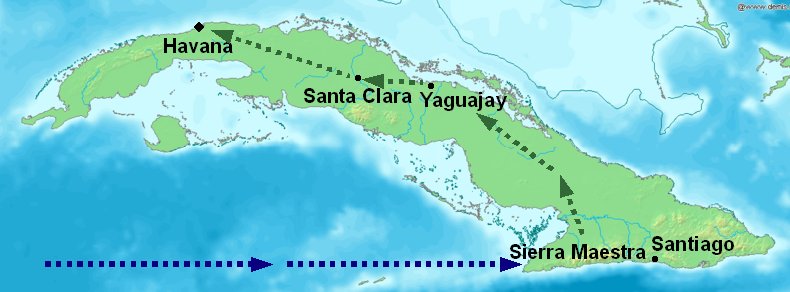
Map of Cuba showing the location of the arrival of the rebels on the Granma yacht in late 1956, the rebels' stronghold in the Sierra Maestra, and Guevara's route towards Havana via Las Villas Province in December 1958
Guevara, the troop's physician, writes that during this battle he laid down his knapsack containing medical supplies in order to pick up a box of ammunition dropped by a fleeing comrade, a moment which he later recalled as marking his transition from physician to combatant.[1] Only 15-20 rebels survived these initial engagements to later re-group as a bedraggled fighting force; they then moved deep into the Sierra Maestra mountains where they received support from Frank País's network and local guajiro country folk, including Celia Sánchez Mandulay, Huber Matos, the bandit Cresencio Pérez, and a few covert communists who had been living in those mountains since the 1930s. At their encampments in the distant reaches of the Sierra, they slowly grew in strength, seizing weapons and winning support and recruits from guajiros, montunos and property owners (such as the Babun and Matos) in rural areas and also gaining increasing support from the general population in urban areas. Although the Cuban Communist Party (Partido Socialista Popular) did not back Castro until it was clear he was winning in the middle of 1958, the covert communist cells in the mountains did give assistance. The main source of support, including funding, arms supply and a large contingent of fighters continued to be the non-communist urban branch of the 26th of July Movement, directed by Frank País and, after his death, by "Daniel" (nom de guerre of René Ramos Latour). Guevara did not get along with the Frank País contingent and feuded and criticized them continuously. At El Uvero there were more of Frank País's followers among the combatants than "mountain" guerrillas. Guevara ridiculed these urban fighters for lack of fitness, while he himself was riding a mule because of his asthma.


Guevara gradually gained enough respect and trust from his fellow Sierra fighters for Castro to appoint him commandante of a second army column. In his new role he became something of a "a fanatic of example", a strict disciplinarian whose harsh methods were notorious amongst the rebels.[2] Deserters were severely punished, and on a number of occasions Guevara sent execution squads into the bush to hunt down those he believed were betraying the revolution by seeking an escape. After one such execution, Guevara wrote that he was "not very convinced of the legality of the death, although I used it as an example".[3] On another occasion, Guevara ordered the execution of a deserter whom he was informed had "victimized an entire section of the population, perhaps in collusion with the army". After the man had been shot three times, Guevara wrote; "those who took advantage of the prevailing atmosphere in the area to commit crimes was unfortunately, not infrequent in the Sierra Maestra".[3]
He was selected by Fidel Castro to lead one of the three columns that crossed the plains of the Cauto; it is said that during this westward march he received protection from the escopeteros—men armed with shotguns—of the "Muchachos" de Orlando Lara Batista[4][5] who had already linked up with Camilo Cienfuegos and other main force elements of Fidel Castro's Column 1.[citation needed] Then Guevara crossed, with the support of local Escopeteros the even flatter plains of Camagüey heading towards the mountainous Santa Clara province in central Cuba which his column reached in late 1958.

Friday, April 6, 2007

Che Gueavara


Beatiful portait..

Friday, March 16, 2007

Newspaper Articles Concerning Guevara (with pictures)


Format: Date, Subject/Title, Source.
October 17, 2005. Che Guevara Legacy Lives On in Bolivia: Seoul Times / BBC.
October 17, 2005. Commemorated in Nicaragua death of Che Guevara: ahora.cu
October 9, 2005. Che Guevara, hope of the world: Dominican Daily, Dominican Republic
October 8, 2005: On this day: October 9, 1967 - Che Guevara 'Shot Dead'
June 15, 2003. Che would have turned 75 today: Reuters.
June 9, 2001. Venezuela's Chavez Declares Revolutionary Campaign: Reuters.
May 25, 2001. Cuba's 'Che' Photographer Korda Dies in Paris: Reuters.
September 10, 2000. Alberto Korda against vodka ad image of 'Che': Reuters/Times of India.
August 9, 2000. Guevara's image used to sell vodka: AP.
January 1, 1999. Castro returns to scene of revolution's triumph: AP.
December 29, 1998. Cuba Honors Guerrilla Hero ``Tania'' Before Burial: Reuters.
December 2, 1998. Colombia guerrilla negotiator: We will not lay down arms: AP.Not directly Che-related, but read closely and you might see a connection.
April 30, 1998. Che felt betrayed by Castro, Bolivian officer claims: AP.
April 17, 1998. Some Cuban Exiles Offended by Taco Bell Ad: CNN, Reuters.
March/April 1998. Che Guevara's Irish Roots: Irish America.
February 20, 1998. More Bodies of Che Guevara Comrades Found in Bolivia: Reuters.
Oct. 18, 1997. Che buried in Cuba 30 years after death: CBC Newsworld.
Oct. 18, 1997. Article about Che's funeral service: Reuters, scanned from the St. Catharines Standard.
Oct. 17, 1997. Cuba Buries Che, the Man, but Keeps the Myth Alive: AP.
Oct. 17, 1997. Article about Che's funeral: CNN.
Oct. 12, 1997. Castro digs up memories of Che Guevara: CBC Newsworld.
Oct. 12, 1997. Article about Che's bones in Havana: Toronto Star.
Oct. 8, 1997. Honored, Despised Or Exploited, Che Lives On: Reuters.
Oct. 7, 1997. Thousands Remember 'Che' Guevara: AP.
Oct. 3, 1997. Reclaiming Che's Legacy: Norman Stockwell, The Capital Times. (also listed at the top of this site under Various Biographical Information)
September 1997. 30th anniversary of Che Guevara's death.
August 15, 1997. Argentines reviving the legend of Che Guevara: Movies, paraphernalia celebrate 30th anniversary of his death. From CNN.
July 24, 1997. Marxist revolutionary seizes market place from beyond grave (a look at Che's image in marketing): CNN.
July 21, 1997. Che Chic: Che "has become a pop icon throughout the world": Newsweek.
July 21, 1997. Small update- Che's bones: Canadian edition of Time Magazine.
July 7, 1997. Article about Che's remains: Reuters, Philadelphia Inquirer.
~July 10, 1997. Bones Being Checked with Che's Medical File: AP.

Monday, February 26, 2007

How a revolutionary became a rock star


A film looks at the man and moment that made a leader immortal, writes Gabriel Wilder.

It is one of the world's most reproduced images, spanning continents and generations, yet few know of the hand that snapped it. Now a film documents the origins of the iconic picture of Che Guevara - reprinted on millions of posters and T-shirts since it was taken in 1960 - and the photographer who created it.

"There is a reason why this image is still so popular," says Hector Cruz Sandoval, the director of Kordavision.

"The look is tremendous: those fiery eyes and the long hair, even what he was wearing was kind of cool; but [mostly] it's that internal fiery look of conviction."

Cruz Sandoval's film, which is screening as part of the second Sydney Latin American Film Festival, portrays the life of Alberto Diaz Gutierrez - "Korda" - a photographer living and working in a country at a time of seismic change.

It opens with news footage of the explosion of the French ship La Coubre at the Havana docks on March 4, 1960. (The film portrays it as an act of sabotage; like much of Cuba's history, this has been disputed.) More than 100 Cubans were killed and a memorial service was held the next day, with Fidel Castro delivering a speech while various leading lights of the new government and celebrities, including Guevara, Jean Paul Sartre and Simone de Beauvoir, looked on.

"I was taking photos of everything during the ceremony," Korda tells Cruz Sandoval's camera, as he stands on the street where the service was held more than four decades ago. "But you couldn't see Che. He was in the second row. Suddenly he peered out to the edge of the platform and looked at the crowd that filled the street."

Korda clicked the shutter and an icon was born.

The newspaper that had sent him to cover the event didn't publish the image but Korda liked it and made a print for his wall. In 1967 he gave it to the radical Italian publisher Giangiacomo Feltrinelli for use on the cover of an edition of Guevara's diaries. Feltrinelli had posters made and these were used by students in the demonstrations sweeping Europe at the time. Since then, it has become ubiquitous, as recognisable to teenagers today as it is to their parents and grandparents.

And despite its appropriation by popular culture and marketing (Korda won a settlement against an advertising company that used the image with neither permission nor payment), Cruz Sandoval believes it remains a symbol of idealism.

"I think people … want to be anti or pro something. They want to feel something. They want to believe in something. "Unfortunately there are a lot of people who buy a $20 T-shirt with images of Che thinking they've bought part of the revolution … [but] you don't buy a revolution with $20; you've gotta die, sweat blood, tears, all of that stuff. You gotta fight for it."

Born in Los Angeles to Mexican parents, Cruz Sandoval, now 41, didn't give Cuba much thought until he was sent there to cover a visit by Pope John Paul and realised the US embargo had prevented him from knowing anything at all about this nearby country.

"It intrigued me tremendously, and I thought, 'Well, why the hell can't I come down here and find out more about it?"'

Cruz Sandoval met Korda, who had been asked by the Vatican to photograph the pope's visit - and decided to make a film about the man and his work.

Thanks to Korda, Cruz Sandoval was given unprecedented access to the national archives, and the film is brimming with never-before-seen photographs and archival film of the revolution in its infancy.

"I was able to scan hundreds of contact sheets that represented the majority of the revolutionary work, and I was also able to see some [of his] fashion photography that I was completely unaware of."

Cruz Sandoval says the skills Korda developed while working in fashion made his reportage stand out.

"I think that [the fashion photography] actually lent itself to the new revolutionary work he was doing and created a unique style in the sense that he created a revolution glam look. He really helped the new Cuban leaders to promote the new idealism."

In 2001, while the director was still working with the photographer on the film, Korda died of a heart attack.

"It struck me pretty hard," Cruz Sandoval says. "I kind of shut down [for] about a year, a year and a half … put the project on the shelf for a little while. But I was able to emotionally and spiritually and financially come back to my feet and finish it off."

He remembers Korda as a gifted photographer who never boasted about his achievements.

"He really taught me how to see a little better. I was pretty naive about certain things of Cuban history. And now I know a little bit more. And I think that's the essence of documentary work - we need more information to make educated decisions."

Hector Cruz Sandoval will introduce Kordavision at the Chauvel Cinema on Sunday at 6.30pm. The film also screens at Club Marconi on March 4. More information at sydneylatinofilmfestival.org

Angelina Jolie, the sexiest in the world!


London, Feb 25 (IANS) Hollywood beauty Angelina Jolie has been voted the sexiest person in the world, according to a new poll.

Jolie, 31, came four places above her partner Brad Pitt and also beat Elvis Presley, who came second, and Marilyn Monroe who was third. Lara Croft - the Tomb Raider video game character played by Jolie on the big screen - came fifth, reported contactmusic.com.


The top 10 - as compiled by British TV network Channel 4 - is as follows:
1. Angelina Jolie
2. Elvis Presley
3. Marilyn Monroe
4. Beyonce Knowles
5. Brad Pitt
6. Lara Croft
7. George Clooney
8. Kylie Minogue
9. Johnny Depp
10. Scarlett Johansson.

source

She is Angelina Jolie..

Angelina Jolie (born June 4, 1975) is an American film actress, former fashion model, and a Goodwill Ambassador for the UN Refugee Agency. She is often cited by popular media as one of the world's most beautiful women[1] and her off-screen life is widely reported. She has received three Golden Globe Awards, two Screen Actors Guild Awards, and an Academy Award.
After appearing as a child alongside her father Jon Voight in the 1982 film Lookin' to Get Out, Jolie's acting career began in earnest a decade later with the low budget production Cyborg 2 (1993) and she played her first leading role in a major film in Hackers (1995). She appeared in the critically acclaimed biographical films George Wallace (1997) and Gia (1998), and won an Academy Award for Best Supporting Actress for her performance in the drama Girl, Interrupted (1999). She achieved international fame as a result of her portrayal of videogame heroine Lara Croft in Lara Croft: Tomb Raider (2001), and since then has established herself as one of the best known and highest paid actresses in Hollywood. She had her biggest commercial success with the action-comedy Mr. & Mrs. Smith (2005).[2]
Divorced from actors Jonny Lee Miller and Billy Bob Thornton, Jolie currently lives with actor Brad Pitt, in a relationship that has attracted worldwide media attention.[3] Jolie and Pitt have two adopted children, Maddox and Zahara, and a biological child, Shiloh. Jolie has promoted humanitarian causes throughout the world, and is noted for her work with refugees through UNHCR.

Wednesday, February 21, 2007

What is it about Che?

What is it about Che Guevara that makes him mythical nearly 30 years after his death?
Che became rooted not only in worldwide political mythology, but even in American pop culture.