





Monday, May 21, 2007
Tuesday, May 15, 2007
Angelina Jolie and Pitt too busy to 'date'
 Actress Angelina Jolie struggles to spend quality time alone with boyfriend Brad Pitt because they're so busy running around after their four children.
The Hollywood couple - who live with their four kids Maddox, Pax, Zahara and Shiloh - hardly ever manage a romantic evening together, because their kids need to be entertained.
The couple only adopted Vietnamese tot Pax in March (07), so its too soon to leave the family with babysitters.
She tells Readers Digest magazine, "We hang out. We try to talk over the swing set. We'll have a date night once everybody is settled. "Especially now with Pax; he still gets scared if I'm gone more than a few hours. But we'll get them occupied with a movie and popcorn and try to run off and lock the door for a bit."
Saturday, May 12, 2007
Madonna’s Marriage is in Crisis
Pop queen Madonna and film directory Guy Ritchie’s marriage is in great crisis after the adoption of little David.

-Their relationship is totally cold, they sleep in separate bedrooms, Guy holds a grudge because of her “I want to have everything under control” behaviour and he disagrees with her Kabbalah obsession- said their close friend.
Only the kids are still saving them. Madonna has daughter Lourdes from her first marriage, whom Guy adopted, they have a 6-year-old son Rocco together and little David, who was adopted by Madonna last year.
-Madonna is planning to adopt another child with which Guy disagrees. The whole scandal over David`s adoption was too much for him- said the close source close to the couple.
The couple got married in 2000 at the Skibo castle in Scotland, but it seems that their marriage will not last long.
Who knows what else will happen. Madonna is leaving for New York to record a new album, while Guy is staying in England. Perhaps time apart will be crucial for their marriage, newspftheworld.com writes.
Guevara met Fidel Castro and Fidel's brother Raúl in Mexico City where the two were living after having been amnestied from prison in Cuba in 1955. The Castro brothers were preparing to return to Cuba with an expeditionary force in an attempt to overthrow General Fulgencio Batista, who had assumed dictatorial powers following a coup d'état during the 1952 presidential elections. Guevara quickly joined the "26th of July Movement (M-26-7)", named in commemoration of the date of the failed attack on the Moncada barracks that had been the cause of the Castros' imprisonment.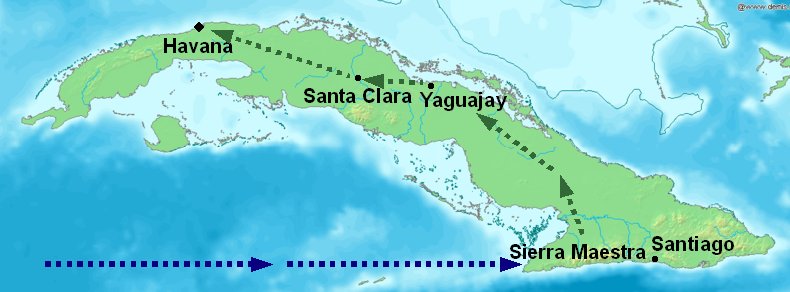
The Castro brothers, Guevara, and approximately 80 other guerrillas departed from Tuxpan, Veracruz, aboard the cabin cruiser Granma in November 1956. Guevara was one of only four non-Cubans aboard. The landing was planned to coincide with an uprising, organized by Frank País, in Santiago de Cuba on 30 November, but Granma was delayed, and the uprising was suppressed. Shortly after disembarking in a swampy area near Niquero in southeastern Cuba on 2 December, the expeditionary unit was attacked by Batista's forces. In the aftermath of the battle of Alegría de Pío where infantry, air and naval attacks killed three rebels, the unit was dispersed into several small groups that lost contact with each other.
Map of Cuba showing the location of the arrival of the rebels on the Granma yacht in late 1956, the rebels' stronghold in the Sierra Maestra, and Guevara's route towards Havana via Las Villas Province in December 1958
Guevara, the troop's physician, writes that during this battle he laid down his knapsack containing medical supplies in order to pick up a box of ammunition dropped by a fleeing comrade, a moment which he later recalled as marking his transition from physician to combatant.[1] Only 15-20 rebels survived these initial engagements to later re-group as a bedraggled fighting force; they then moved deep into the Sierra Maestra mountains where they received support from Frank País's network and local guajiro country folk, including Celia Sánchez Mandulay, Huber Matos, the bandit Cresencio Pérez, and a few covert communists who had been living in those mountains since the 1930s. At their encampments in the distant reaches of the Sierra, they slowly grew in strength, seizing weapons and winning support and recruits from guajiros, montunos and property owners (such as the Babun and Matos) in rural areas and also gaining increasing support from the general population in urban areas. Although the Cuban Communist Party (Partido Socialista Popular) did not back Castro until it was clear he was winning in the middle of 1958, the covert communist cells in the mountains did give assistance. The main source of support, including funding, arms supply and a large contingent of fighters continued to be the non-communist urban branch of the 26th of July Movement, directed by Frank País and, after his death, by "Daniel" (nom de guerre of René Ramos Latour). Guevara did not get along with the Frank País contingent and feuded and criticized them continuously. At El Uvero there were more of Frank País's followers among the combatants than "mountain" guerrillas. Guevara ridiculed these urban fighters for lack of fitness, while he himself was riding a mule because of his asthma.
Guevara gradually gained enough respect and trust from his fellow Sierra fighters for Castro to appoint him commandante of a second army column. In his new role he became something of a "a fanatic of example", a strict disciplinarian whose harsh methods were notorious amongst the rebels.[2] Deserters were severely punished, and on a number of occasions Guevara sent execution squads into the bush to hunt down those he believed were betraying the revolution by seeking an escape. After one such execution, Guevara wrote that he was "not very convinced of the legality of the death, although I used it as an example".[3] On another occasion, Guevara ordered the execution of a deserter whom he was informed had "victimized an entire section of the population, perhaps in collusion with the army". After the man had been shot three times, Guevara wrote; "those who took advantage of the prevailing atmosphere in the area to commit crimes was unfortunately, not infrequent in the Sierra Maestra".[3]
He was selected by Fidel Castro to lead one of the three columns that crossed the plains of the Cauto; it is said that during this westward march he received protection from the escopeteros—men armed with shotguns—of the "Muchachos" de Orlando Lara Batista[4][5] who had already linked up with Camilo Cienfuegos and other main force elements of Fidel Castro's Column 1.[citation needed] Then Guevara crossed, with the support of local Escopeteros the even flatter plains of Camagüey heading towards the mountainous Santa Clara province in central Cuba which his column reached in late 1958.
Friday, April 6, 2007


Friday, March 16, 2007
Newspaper Articles Concerning Guevara (with pictures)

Format: Date, Subject/Title, Source.
October 17, 2005. Che Guevara Legacy Lives On in Bolivia: Seoul Times / BBC.
October 17, 2005. Commemorated in Nicaragua death of Che Guevara: ahora.cu
October 9, 2005. Che Guevara, hope of the world: Dominican Daily, Dominican Republic
October 8, 2005: On this day: October 9, 1967 - Che Guevara 'Shot Dead'
June 15, 2003. Che would have turned 75 today: Reuters.
June 9, 2001. Venezuela's Chavez Declares Revolutionary Campaign: Reuters.
May 25, 2001. Cuba's 'Che' Photographer Korda Dies in Paris: Reuters.
September 10, 2000. Alberto Korda against vodka ad image of 'Che': Reuters/Times of India.
August 9, 2000. Guevara's image used to sell vodka: AP.
January 1, 1999. Castro returns to scene of revolution's triumph: AP.
December 29, 1998. Cuba Honors Guerrilla Hero ``Tania'' Before Burial: Reuters.
December 2, 1998. Colombia guerrilla negotiator: We will not lay down arms: AP.Not directly Che-related, but read closely and you might see a connection.
April 30, 1998. Che felt betrayed by Castro, Bolivian officer claims: AP.
April 17, 1998. Some Cuban Exiles Offended by Taco Bell Ad: CNN, Reuters.
March/April 1998. Che Guevara's Irish Roots: Irish America.
February 20, 1998. More Bodies of Che Guevara Comrades Found in Bolivia: Reuters.
Oct. 18, 1997. Che buried in Cuba 30 years after death: CBC Newsworld.
Oct. 18, 1997. Article about Che's funeral service: Reuters, scanned from the St. Catharines Standard.
Oct. 17, 1997. Cuba Buries Che, the Man, but Keeps the Myth Alive: AP.
Oct. 17, 1997. Article about Che's funeral: CNN.
Oct. 12, 1997. Castro digs up memories of Che Guevara: CBC Newsworld.
Oct. 12, 1997. Article about Che's bones in Havana: Toronto Star.
Oct. 8, 1997. Honored, Despised Or Exploited, Che Lives On: Reuters.
Oct. 7, 1997. Thousands Remember 'Che' Guevara: AP.
Oct. 3, 1997. Reclaiming Che's Legacy: Norman Stockwell, The Capital Times. (also listed at the top of this site under Various Biographical Information)
September 1997. 30th anniversary of Che Guevara's death.
August 15, 1997. Argentines reviving the legend of Che Guevara: Movies, paraphernalia celebrate 30th anniversary of his death. From CNN.
July 24, 1997. Marxist revolutionary seizes market place from beyond grave (a look at Che's image in marketing): CNN.
July 21, 1997. Che Chic: Che "has become a pop icon throughout the world": Newsweek.
July 21, 1997. Small update- Che's bones: Canadian edition of Time Magazine.
July 7, 1997. Article about Che's remains: Reuters, Philadelphia Inquirer.
~July 10, 1997. Bones Being Checked with Che's Medical File: AP.
Monday, February 26, 2007
How a revolutionary became a rock star

A film looks at the man and moment that made a leader immortal, writes Gabriel Wilder.
It is one of the world's most reproduced images, spanning continents and generations, yet few know of the hand that snapped it. Now a film documents the origins of the iconic picture of Che Guevara - reprinted on millions of posters and T-shirts since it was taken in 1960 - and the photographer who created it.
"There is a reason why this image is still so popular," says Hector Cruz Sandoval, the director of Kordavision.
"The look is tremendous: those fiery eyes and the long hair, even what he was wearing was kind of cool; but [mostly] it's that internal fiery look of conviction."
Cruz Sandoval's film, which is screening as part of the second Sydney Latin American Film Festival, portrays the life of Alberto Diaz Gutierrez - "Korda" - a photographer living and working in a country at a time of seismic change.
It opens with news footage of the explosion of the French ship La Coubre at the Havana docks on March 4, 1960. (The film portrays it as an act of sabotage; like much of Cuba's history, this has been disputed.) More than 100 Cubans were killed and a memorial service was held the next day, with Fidel Castro delivering a speech while various leading lights of the new government and celebrities, including Guevara, Jean Paul Sartre and Simone de Beauvoir, looked on.
"I was taking photos of everything during the ceremony," Korda tells Cruz Sandoval's camera, as he stands on the street where the service was held more than four decades ago. "But you couldn't see Che. He was in the second row. Suddenly he peered out to the edge of the platform and looked at the crowd that filled the street."
Korda clicked the shutter and an icon was born.
The newspaper that had sent him to cover the event didn't publish the image but Korda liked it and made a print for his wall. In 1967 he gave it to the radical Italian publisher Giangiacomo Feltrinelli for use on the cover of an edition of Guevara's diaries. Feltrinelli had posters made and these were used by students in the demonstrations sweeping Europe at the time. Since then, it has become ubiquitous, as recognisable to teenagers today as it is to their parents and grandparents.
And despite its appropriation by popular culture and marketing (Korda won a settlement against an advertising company that used the image with neither permission nor payment), Cruz Sandoval believes it remains a symbol of idealism.
"I think people … want to be anti or pro something. They want to feel something. They want to believe in something. "Unfortunately there are a lot of people who buy a $20 T-shirt with images of Che thinking they've bought part of the revolution … [but] you don't buy a revolution with $20; you've gotta die, sweat blood, tears, all of that stuff. You gotta fight for it."
Born in Los Angeles to Mexican parents, Cruz Sandoval, now 41, didn't give Cuba much thought until he was sent there to cover a visit by Pope John Paul and realised the US embargo had prevented him from knowing anything at all about this nearby country.
"It intrigued me tremendously, and I thought, 'Well, why the hell can't I come down here and find out more about it?"'
Cruz Sandoval met Korda, who had been asked by the Vatican to photograph the pope's visit - and decided to make a film about the man and his work.
Thanks to Korda, Cruz Sandoval was given unprecedented access to the national archives, and the film is brimming with never-before-seen photographs and archival film of the revolution in its infancy.
"I was able to scan hundreds of contact sheets that represented the majority of the revolutionary work, and I was also able to see some [of his] fashion photography that I was completely unaware of."
Cruz Sandoval says the skills Korda developed while working in fashion made his reportage stand out.
"I think that [the fashion photography] actually lent itself to the new revolutionary work he was doing and created a unique style in the sense that he created a revolution glam look. He really helped the new Cuban leaders to promote the new idealism."
In 2001, while the director was still working with the photographer on the film, Korda died of a heart attack.
"It struck me pretty hard," Cruz Sandoval says. "I kind of shut down [for] about a year, a year and a half … put the project on the shelf for a little while. But I was able to emotionally and spiritually and financially come back to my feet and finish it off."
He remembers Korda as a gifted photographer who never boasted about his achievements.
"He really taught me how to see a little better. I was pretty naive about certain things of Cuban history. And now I know a little bit more. And I think that's the essence of documentary work - we need more information to make educated decisions."
Hector Cruz Sandoval will introduce Kordavision at the Chauvel Cinema on Sunday at 6.30pm. The film also screens at Club Marconi on March 4. More information at sydneylatinofilmfestival.org
Subscribe to:
Posts (Atom)